
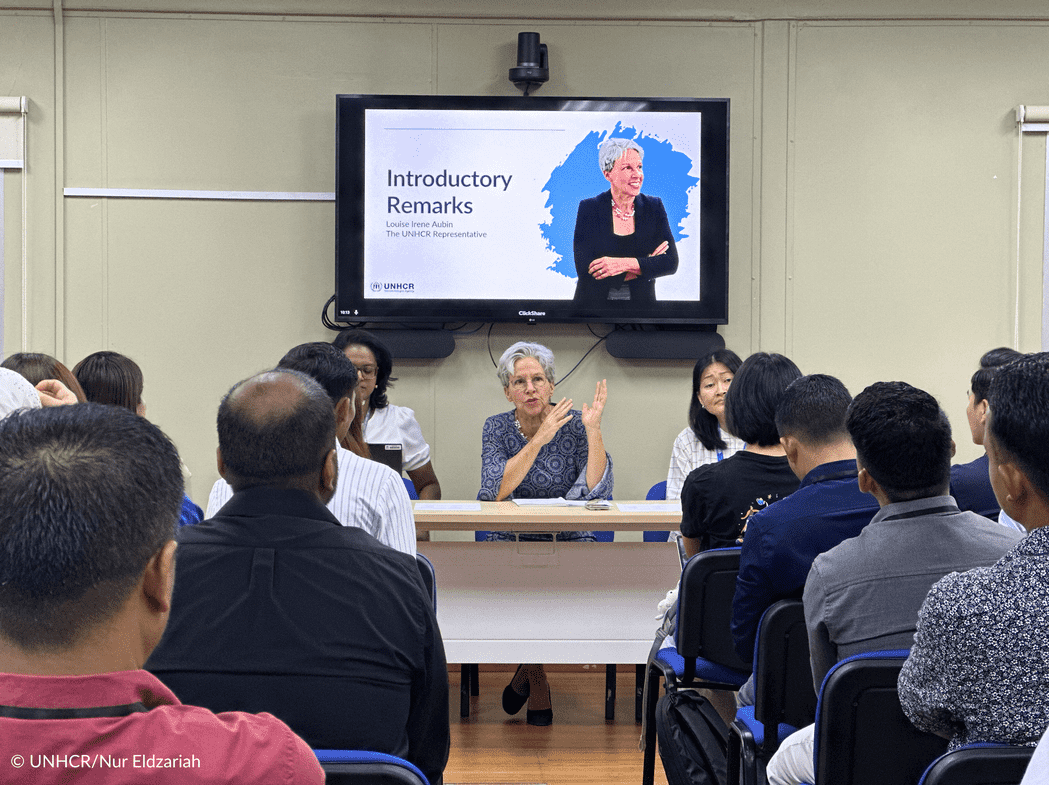
UNHCR Malaysia held its first Community Leaders Townhall of 2026 on 12 March, bringing together forty leaders from different refugee communities to discuss key updates including on registration and resettlement. For the first time, the Community‑Based Protection (CBP) team organised the session in a hybrid format, allowing community leaders in Johor and Penang to participate remotely with support from Cahaya Surya Bakti (CSB) and the Penang Refugee Network (PRN).
In the introductory remarks, the UNHCR Representative Louise Irene Aubin explained that since 2025, many services and solutions previously available to refugees have been reduced due to shrinking resources and the impact of continued global conflicts. She noted that UNHCR has had to make difficult decisions to ensure that essential services in Malaysia can continue. Louise also shared that in 2026, UNHCR will keep working closely with the Government on the Dokumen Pendaftaran Pelarian (DPP). She highlighted the positive momentum from the Parliamentary Symposium on refugee access to education and legal work, and the upcoming engagements with judges and religious scholars aimed at strengthening refugee protection through both legal and faith‑based perspectives.
The Registration Unit presented its 2026 strategy and targets, addressing concerns raised by communities regarding registration delays, how appointments are allocated, long‑pending applications, the inclusion of family members/newborns and challenges linked to changing contact information. Community members were reminded to keep their contact details updated to improve communication. Leaders were also introduced to the upcoming Digital Gateway service and encouraged to raise awareness among their members about the importance of email use for future processes.
On resettlement, the Durable Solutions Unit clarified that resettlement is based solely on individual needs and protection risks, not on how long someone has lived in Malaysia. With global resettlement opportunities continuing to decline, communities were encouraged to explore complementary pathways such as education and sponsorship programmes in countries like Australia and Canada. Community leaders were reminded to guide their members to contact embassies directly for information on these options.
Community-Based Protection (CBP) colleagues also shared that funding for NGO partners remains limited, although essential protection services continue for children at risk, survivors of gender‑based violence and other vulnerable individuals. CBP has issued warnings to certain community groups involved in harmful practices and noted that stronger enforcement will be a priority in the coming year. Communities also raised concerns about access to healthcare and the risks faced by individuals who are repeatedly arrested. UNHCR continues to follow up on these issues with relevant authorities and encourages leaders to share specific cases to support advocacy efforts.
Throughout the session, UNHCR emphasised the importance of continued collaboration and communication with community leaders to strengthen refugee protection in Malaysia. Feedback received from the attendees showed that more than ninety percent of participants found the information shared by the Registration and Resettlement unit very helpful in clarifying the concerns raised by their communities.